

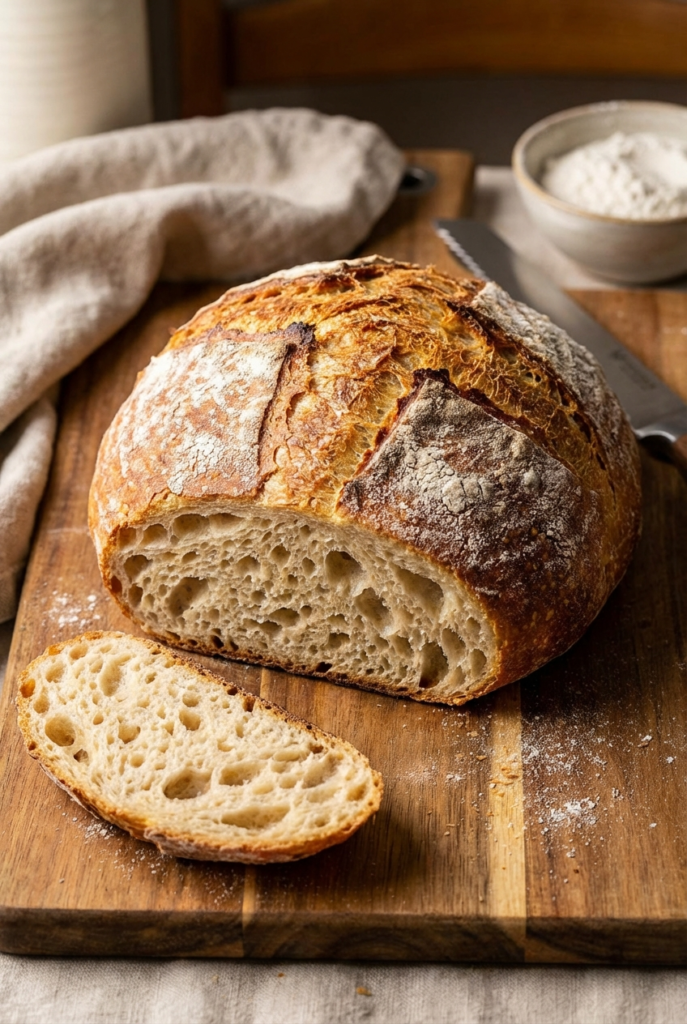
This World’s Easiest Yeast Bread is a phenomenal, no-knead artisan bread recipe that delivers bakery-quality results with just 3 minutes of active effort.
Whether you’re a complete beginner or a bread connoisseur, you’ll love the thick, crispy crust and the chewy, airy crumb with large holes, much like a traditional sourdough. It’s an incredibly forgiving “gold nugget” recipe that will make you never want to buy store-bought bread again!

❤️ Why You’ll Love This Recipe
• Minimal Effort: Requires no kneading and no stand mixer. You won’t even get your hands dirty!
• Incredibly Forgiving: The dough is very flexible, with rise times ranging from 2 hours to 3 days—you choose what fits your schedule.
• Bakery Quality at Home: Achieve that signature thick, crunchy crust and a moist, chewy interior with beautiful air pockets.
• Only 4 Ingredients: Made with simple pantry staples: flour, yeast, salt, and water.
• Versatile Baking Options: While a Dutch oven is ideal for that “steam oven” effect, you can easily bake this on a simple tray with great results.
🛠 Tools You’ll Need
• Large Mixing Bowl (for the initial mix and rise)
• Wooden Spoon (use the handle for easy mixing)
• Dutch Oven / Cast Iron Pot (26cm/10″ or larger, for the best crust)
• Parchment Paper (to transfer the wet dough easily)
• Dough Scraper or Spatula (to help shape the sticky dough)
• Wire Cooling Rack (to prevent a soggy bottom while cooling)
🥖 Key Ingredients
• Bread Flour or All-Purpose Flour (3 cups / 450g): Bread flour is recommended for a chewier texture and bigger holes, but all-purpose works beautifully too.
• Instant or Rapid Rise Yeast (2 tsp): No need to dissolve in water first—just mix it straight in! (See notes for Active Dry Yeast).
• Cooking / Kosher Salt (2 tsp): Essential for flavor and controlling the yeast fermentation. Avoid fine table salt if possible.
• Very Warm Tap Water (1 1/2 cups / 375ml): Not boiling! Aim for around 55°C/130°F to activate the yeast without killing it.
• Extra Flour (1 1/2 tbsp): For dusting your work surface during the rough shaping.
✨ How to Make Artisan No-Knead Bread
1. Mix the Dough: In a large bowl, combine the flour, yeast, and salt. Add the warm water and mix with the handle of a wooden spoon until all flour is incorporated. The dough will be wet, sticky, and sloppy—this is exactly what you want!
2. The First Rise: Cover the bowl tightly with cling wrap. Place it in a warm spot (25–30°C / 77–86°F) for 2 to 3 hours. The dough should double in size, become bubbly on top, and wobbly like jelly.
3. Optional Flavor Development: For the best taste, move the risen dough to the fridge for 8 hours up to 3 days. This slow fermentation creates a deeper, sourdough-like flavor.
4. Preheat Your “Oven”: 30 minutes before baking, place your empty Dutch oven (with the lid on) into the oven and preheat to 230°C / 450°F.
5. Shape (Roughly!): Scrape the sticky dough onto a floured surface. Fold the sides inward about 6 times to form a rough round shape.
6. Transfer: Flip the dough upside down onto a piece of parchment paper (smooth side up, seams down).
7. Bake with Steam: Carefully place the dough (with the paper) into the piping hot Dutch oven. Cover with the lid and bake for 30 minutes.
8. Crisp it Up: Remove the lid and bake for another 12 minutes until the crust is deep golden brown.
9. Cooling: Let the bread cool on a wire rack for at least 10 minutes before slicing.
💡 Tips for Success
• Embrace the Stickiness: A wetter dough creates bigger holes and better texture.
• Hot Pot is Key: Preheating the Dutch oven is non-negotiable.
• Check Your Yeast: Expired yeast = no rise.
• The Lid Trick: Steam = oven spring.
• Patience Pays Off: Overnight fridge rise = best flavor.
🆘 Bread Troubleshooting Guide
Problem: My dough isn’t rising.
Likely Cause: Expired yeast or water too hot.
Solution: Check yeast date and water temperature.
Problem: The bread is dense.
Likely Cause: Too much flour or short rise.
Solution: Measure accurately and wait for bubbles.
Problem: Burnt bottom.
Likely Cause: Too much direct heat.
Solution: Add a tray underneath.
Problem: Gummy center.
Likely Cause: Cut too early.
Solution: Wait 10–15 minutes minimum.
👩🍳 Pro Chef Tips
• Bread Flour = Chew
• No Dutch Oven: Add steam with hot water pan
• Flavor Boosters: Garlic, rosemary, cheese
• Emergency Bake: 2-hour rise works
• Reheat: 175°C / 350°F for 5–10 minutes
🥖 Perfect Pairings
• Salted Butter
• Soups & Stews
• Olive Oil & Balsamic
• Bruschetta
• Cheese Board
📦 How to Store
• Room Temp: Airtight, 2 days
• Freezer: Up to 3 months
• Refresh: 180°C / 350°F for 5–8 minutes
🍰 More Recipes You’ll Love
- Chocolate Lofthouse Cookies: Your New Favorite Soft & Fudgy Treat! 🍫🍪
- Cookies & Cream Cookies: Your New Favorite Oreo-Filled Treat!
- Delightful Strawberry Swirl Cookies: A Chewy, Fruity Treat! 🍓✨
- The Ultimate Soft Batch Double Chocolate Chip Cookies

Get Recipes on Pinterest

World’s Easiest Yeast Bread 🥖✨ No-Knead Artisan Bread with Crispy Crust & Chewy Crumb
Description
A no-knead, 4-ingredient artisan bread with a crackly crust and a chewy, airy interior.
Ingredients

Instructions
-
Combine the Dry Ingredients
In a large mixing bowl, add the flour, instant yeast, and salt. Stir briefly to evenly distribute the yeast and salt throughout the flour.
-
Add Water and Form the Dough
Pour the very warm tap water into the bowl. Using the handle of a wooden spoon or a sturdy spatula, mix until all the flour is fully hydrated. The dough will be sticky, loose, and shaggy—this wet consistency is essential for creating large air pockets.
-
First Rise (Room Temperature Fermentation)
Cover the bowl tightly with plastic wrap. Place it in a warm area for 2 to 3 hours, until the dough has doubled in size. The surface should look bubbly and the dough should jiggle when the bowl is gently shaken.
-
Optional Cold Fermentation (Flavor Boost)
For deeper flavor and a more complex, sourdough-style taste, transfer the covered bowl to the refrigerator for anywhere from 8 hours up to 3 days. The longer it rests, the more developed the flavor will be.
-
Preheat the Dutch Oven
Thirty minutes before baking, place the empty Dutch oven with its lid into the oven. Preheat the oven to 230°C / 450°F. This step is crucial to create intense heat and steam for proper oven spring.
-
Shape the Dough (Minimal Handling)
Lightly flour your work surface. Scrape the dough out of the bowl using a dough scraper. Sprinkle the top with a little flour, then fold the edges inward about 5–6 times to form a rough ball. Do not knead.
-
Transfer to Parchment Paper
Flip the dough seam-side down onto a sheet of parchment paper. This makes transferring the dough into the hot pot safe and easy.
-
Bake Covered (Steam Phase)
Carefully remove the hot Dutch oven from the oven. Lift the dough using the parchment paper and place it directly into the pot. Cover immediately with the lid and bake for 30 minutes.
-
Uncover and Crisp the Crust
Remove the lid and continue baking for an additional 10–12 minutes, until the crust turns deep golden brown and sounds hollow when tapped.
-
Cool Before Slicing
Transfer the bread to a wire rack and allow it to cool for at least 10–15 minutes. This resting time allows the interior crumb to finish setting and prevents a gummy texture.
Note
⏳ Make Ahead & Storage
- Refrigerated dough (up to 3 days) 🧊
Prepare the dough as instructed, cover the bowl, and refrigerate for up to 72 hours. The flavor actually improves over time ✨
The dough will be bubbly at first, then may collapse slightly—this is completely normal.
Before baking, shape into a round, place on parchment paper, and let rest 45–60 minutes to take the chill off, then bake. Cold dough doesn’t rise as well. - Baked bread 🍞
Best enjoyed fresh for 2 days. After that, it’s delicious when warmed or toasted 🔥
Store in an airtight container or zip-top bag. This bread stays fresher than most homemade loaves, especially when using bread flour. - Freezing ❄️
Fully baked bread can be frozen for up to 3 months.
🌾 Ingredients & Substitutions
- Flour
- Bread flour creates a chewier, fluffier crumb similar to bakery-style artisan bread 🥖
- All-purpose flour works perfectly too, though the texture will be slightly different.
- For whole wheat flour: start with 30 g (¼ cup) less, then add more as needed since it absorbs more liquid.
- Yeast
- Use yeast labeled instant or rapid-rise.
- If using active dry yeast, dissolve it in the water first (no need to wait for foaming), then add flour and salt and continue as written.
- Salt 🧂
- If using fine table salt, reduce the amount to 1¼ teaspoons to avoid an overly salty loaf.
- Water Temperature 💧
- If it’s too hot to touch comfortably, it will kill the yeast 😬
- Warm and pleasant to the touch is just right 🌡️
🍥 Dough & Rising
- Dough Texture
Texture can vary due to flour brands, humidity, and temperature.- Too dry → add a splash of water
- Too wet → add a small amount of flour
The dough should be soft, slightly sticky, and jiggly.
- Rising Time
Rising depends on room temperature and conditions. Faster or slower is fine—the goal is:
double in size, bubbly surface, and a wobbly consistency. This recipe is very forgiving 😄 👉 If the dough isn’t rising well:- Place the bowl somewhere warm
- Set it in a sink with warm (not hot) water
- Or place it in a slightly warm, turned-off oven
⚠️ Avoid direct indoor sunlight.
If it rises too quickly, refrigerate it while the oven preheats.
🔥 Baking Tips
- Oven Preheating
- For immediate baking, start preheating once the dough is nearly risen
- For chilled dough, preheat while it rests
You can also shape the dough and let it rest for 30 minutes during preheating—this recipe is flexible 👍
- Dutch Oven Method
A Dutch oven traps steam, mimicking professional bakery ovens for a crisp crust ✨- Recommended size: 26 cm / 10 inches or larger
- The pot doesn’t shape the bread—it simply creates steam.
- Use a metal pan (not glass ❌)
- Preheat it in the oven
- Add boiling water when placing the bread inside to create steam
Result: a beautifully golden, crusty loaf 😍
🧠 Extra Notes
- Why Refrigeration Improves Flavor
Cold temperatures slow yeast activity, allowing enzymes to break down starches into sugars—this means more flavor 🌟 - Measuring Matters 📏
Cup sizes vary by country.
As long as you use either cups OR weight/ml consistently, this recipe works perfectly. - Recipe Inspiration
Inspired by a well-known New York Times bread recipe, refined and simplified through years of testing ❤️ - Nutrition
Values are calculated per slice.